
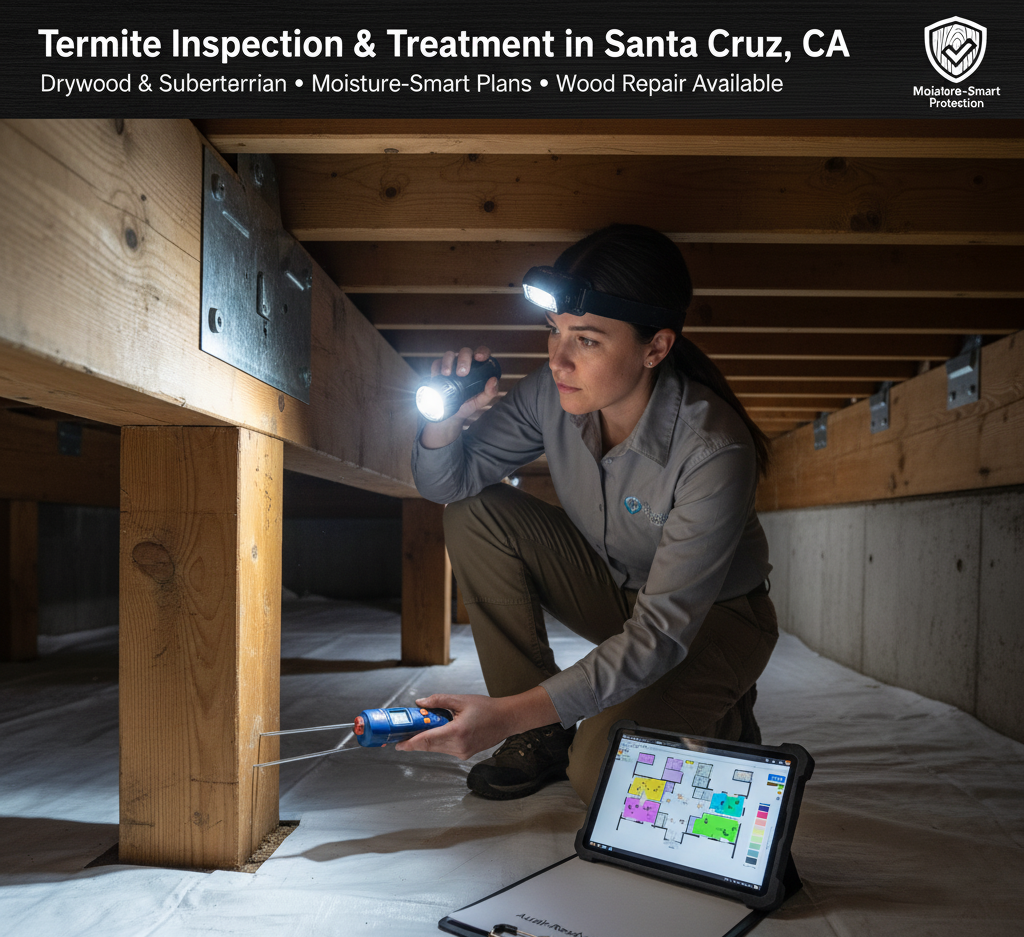
Termite Inspection & Treatment in Santa Cruz, CA
Drywood & Subterranean • Moisture-Smart Plans • Wood Repair Available
Termites don’t announce themselves—they hide in crawlspaces, attics, decks, and fence lines. In Santa Cruz, drywood termites thrive in coastal neighborhoods, while subterranean termites travel via hidden mud tubes. If you’re seeing frass (termite pellets), discarded wings, soft wood, or suspicious paint bubbles, it’s time for a professional inspection and a plan that actually fits your structure and budget.
Need help now?
Call (831) 263 6611
Why Termites Are a Santa Cruz Reality (And How to Tell Them Apart)
Persistent ocean fog, mild temperatures, and year-round humidity keep wood damp and inviting. Older homes with weathered siding and earth-to-wood contact are especially vulnerable; newer builds can still suffer when irrigation or drainage wets structural wood.
If you’re seeing frass (pellets), discarded wings, hollow/soft wood, paint blisters, or mud tubes, you need a species-specific, moisture-aware plan that fits your structure and budget.
Key Termite Species
Drywood (Incisitermes minor)
Targets attics, eaves, trims, furniture; produce frass (pellets) via tiny kick-out holes. Flourishes in dry, mild pockets.
Subterranean (Reticulitermes spp.)
Soil colonies; access wood via cracks and piers using hidden mud tubes. Exploits moisture in raised foundations.
Don’t Wait for Damage
Signs You Need a Termite Inspection
Drywood Evidence
- Frass piles near windowsills, beams, or furniture.
- Discarded wings by light sources (spring/fall swarms).
- Fine etched grooves in exposed wood.
Subterranean Evidence
- Mud tubes on foundations, piers, or crawl walls.
- Live swarmers/termites when probing near ground level.
- Dirt/mud packed into joints or voids.
Structural Damage
- Soft/blistered wood; hollow sound on tap.
- Paint bubbling or sagging/buckling in floors/ceilings.
- Visible damage to deck posts or fence lines.
Moisture-Smart Diagnostics
The Most Thorough Termite Inspection in Santa Cruz
Attic & Crawl Analysis
Framing, sheathing, ventilation, and critical moisture readings to pinpoint risk areas.
Exterior & Foundation Audit
Checking foundation/stem walls, piers, decks, fence lines, and all earth-to-wood contact points.
Conducive Conditions Mapping
Identifying leaks, grading/drainage problems, vegetation touching siding, and poor airflow that invites Subterranean activity.
Your Custom Termite Report
You won’t get a simple ‘yes/no’ answer. You get a detailed plan:
- Photo-rich report with findings and moisture map.
- Treatment options (spot vs. whole-structure).
- Wood-repair and borate protection recommendations.
Want a neutral read before committing? Try our Inspection-Only / Second Opinion — neutral WDO/second look before bidding.
Matched to Your Structure & Budget
The Right Treatment Path for Your Termite Pressure
1. Spot Treatments
Targeted, low disruption solution.
- Drywood: Injectable/foam directly into galleries; patch cleanly.
- Subterranean: Treat at entry points/mud tubes.
Best for: Isolated activity confirmed by inspection.
2. Whole-Structure Options
Decisive reset for widespread issues.
- Comprehensive coverage of inaccessible voids (attic/walls).
- Detailed prep list and scheduling support.
Best for: Widespread, multi-area Drywood involvement or unknown distribution.
3. Subterranean Soil Barriers
Long-term defense for crawlspaces.
- Perimeter/soil treatments to intercept foraging colonies.
- Includes moisture corrections (drainage, grade, irrigation).
Best for: Crawlspace homes and moisture-prone lots.
4. Borate Applications
Preventive and post-repair protection.
- Deep-penetrating borates on framing, trims, and deck supports.
- Odorless, non-corrosive, residual protection against both species.
Best for: New construction, post-repair treatment, and proactive protection.
5. Wood Repair Enhancements
Restoring structural integrity.
- Replace/sister damaged members (joists, headers, etc.).
- Elevate wood off soil with metal post bases.
Best for: Homes with visible, structural termite damage.
Keep conditions unfavorable year-round with our Year-Round Maintenance Plans — seasonal checks for conducive conditions.
Eco-Safe Methods & Long-Term Prevention
Our Safety Promise
- Targeted applications only where needed; no blanket overspray in living zones.
- Bee-safe scheduling to avoid pollinator windows.
- Borate options for long-lasting, low-tox wood protection.
- Clear re-entry guidance for your family and pets.
Your Long-Term Edge (Moisture Management)
- Fix roof/plumbing/irrigation leaks; improve attic/crawl ventilation.
- Correct grading; install/repair gutters and downspouts.
- Break earth-to-wood contact; add gravel breaks or metal post bases.
- Seasonal monitoring—especially after heavy storms or warm snaps.
Close the loop on moisture and entry gaps with Exclusion & Sealing Services — seal moisture/weep-hole vulnerabilities.
Frequently Asked Questions
- Termites vs Ants—how do I tell the difference?
- Termite swarmers have straight antennae, equal-sized wings, and a thick waist. Ants have bent antennae, unequal wings, and a pinched waist. Send a photo—we’ll confirm the species for you.
- Are spot treatments enough?
- For isolated Drywood sites, often yes (when paired with monitoring). Widespread or uncertain distribution suggests a Whole-Structure approach for completeness and peace of mind.
- Do you handle wood repair?
- Yes—we can replace/sister damaged structural members, and then prime/paint and borate-treat the repair to lock in long-term protection against re-infestation.
- How often should I inspect?
- Annually is ideal, or sooner if you see signs. Santa Cruz’s humidity and fog make proactive prevention and monitoring essential.
Ready to Protect Your Home?
Book a free, comprehensive termite inspection & photo report with moisture diagnostics and a custom plan.
Get Your Free Inspection & Quote (831) 263-6611